


One SaucerSwap
Since launch, SaucerSwap has grown from a constant-product automated market maker into a broader execution and liquidity stack spanning V1, V2, V3, staking, governance, cross-chain bridging, analytics, and developer interfaces.
Today, we are launching a rebuilt SaucerSwap web app. The familiar core remains, but the experience around it has been reworked: Swap now compares the strongest eligible V1/V2 AMM quote with V3; Explore turns protocol data into queryable intelligence; Dashboard and Leaderboard add a public-account layer; and the frontend is substantially lighter.
Across the rest of the application, live information and actions are brought forward more consistently. Pool now leads with the liquidity catalogue and creation path. Stake adds on-chain xSAUCE history, verification, and clearer reward context around the existing staking flow. Governance presents active proposals and enactment votes more densely, while Bridge and other utilities are easier to understand and find.
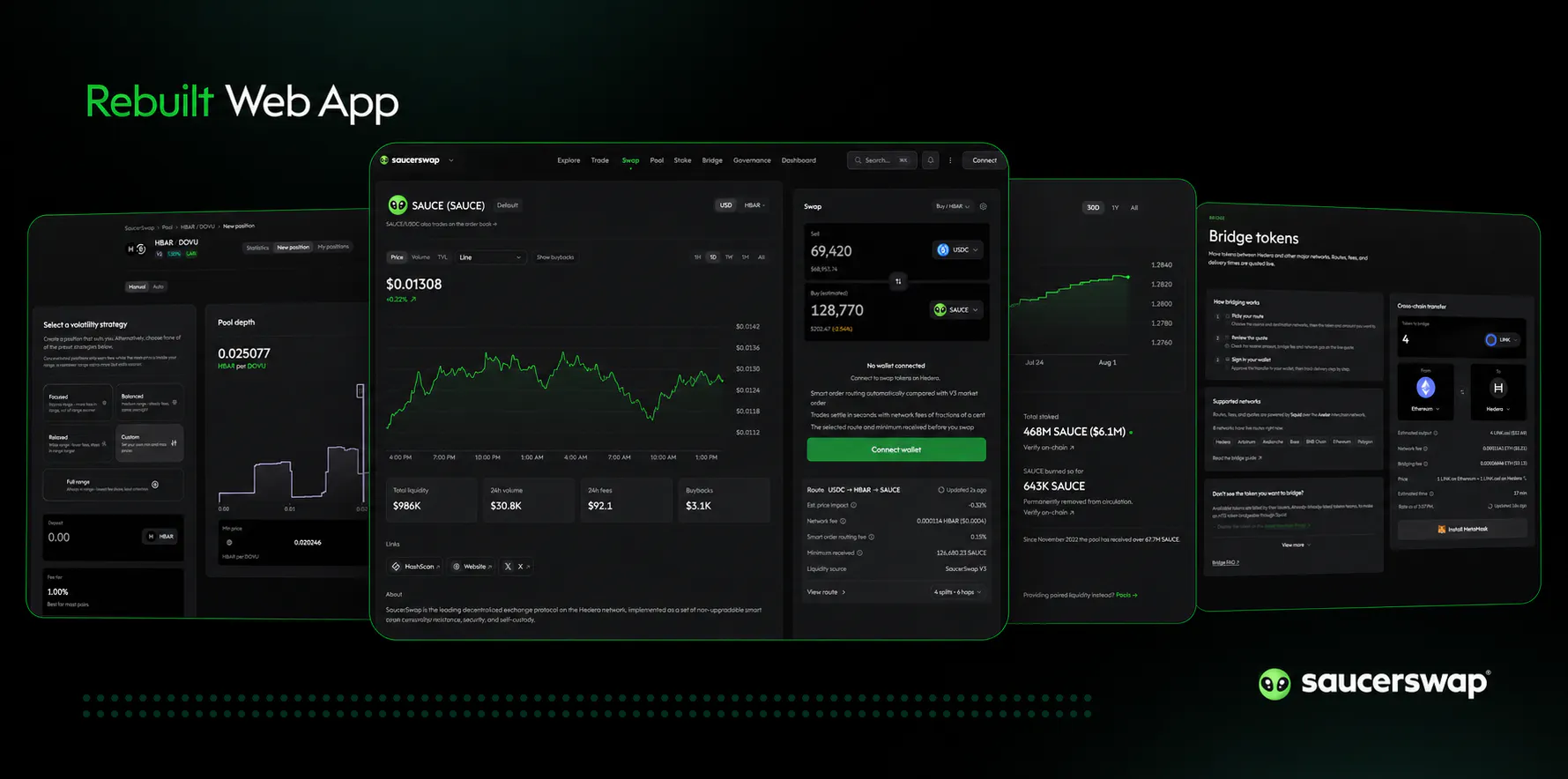
This is not a rejection of the SaucerSwap workflow users already know. Rather, Swap keeps its chart-and-trade composition, while Trade remains the V3 order-book workspace. The goal is to make the protocol easier to navigate as one system without flattening the differences between its products.
The web app arrives today, alongside the broader protocol update. Phase 1 of the ratified tokenomics proposal was activated on September 8, 2026, including a 50% reduction in MasterChef SAUCE emissions. V3 recalibration is planned for early next week, while the recently rebuilt documentation and integration surfaces give developers and agents clearer paths into SaucerSwap data, APIs, contracts, and machine-readable protocol context.
A Unified Quote-Selection Layer
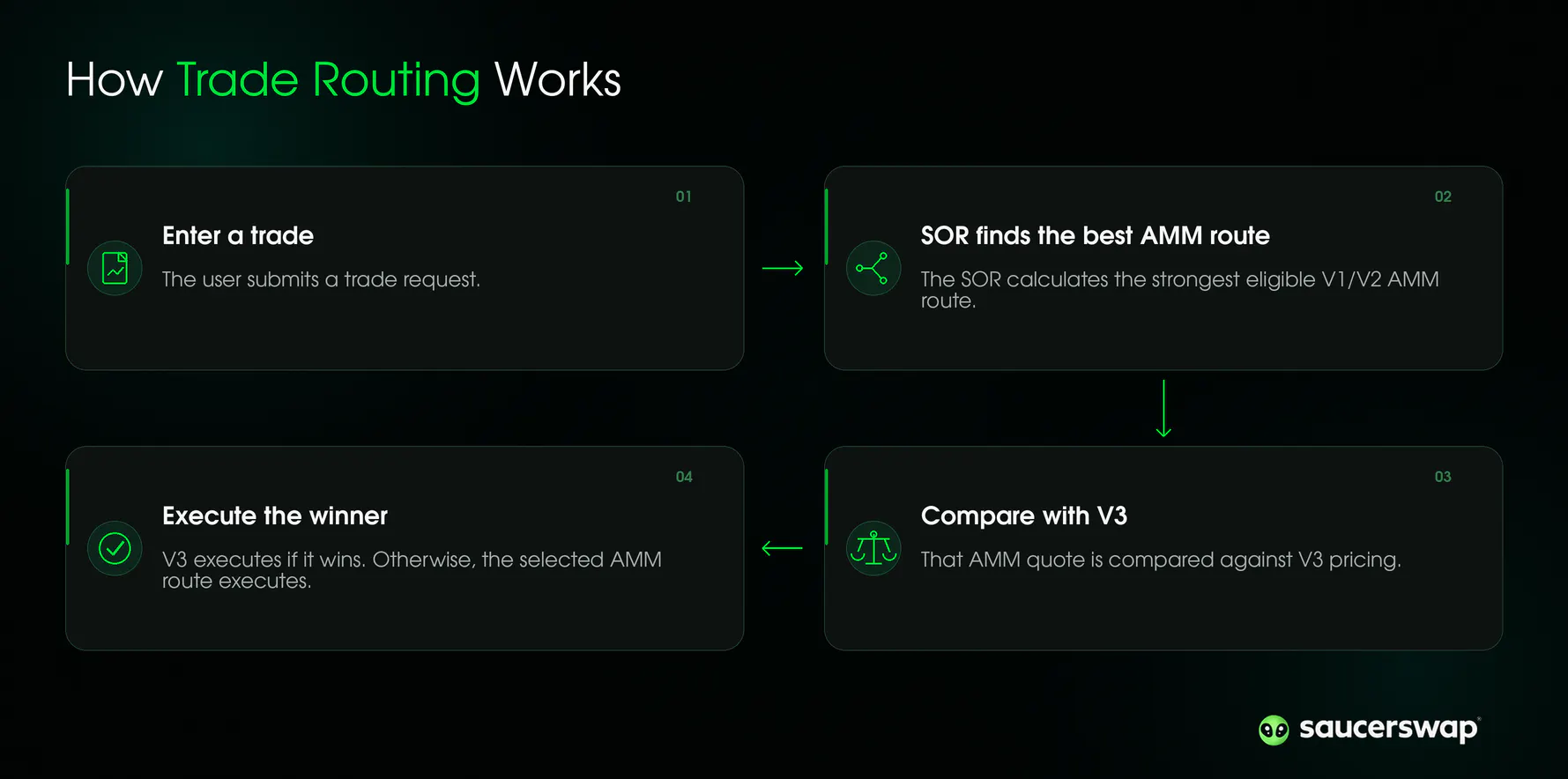
The most consequential change sits beneath Swap. A user enters the tokens and amount once, and SaucerSwap evaluates AMM and order-book liquidity behind the scenes.
The Smart Order Router, or SOR, is the off-chain quoting layer. It scans eligible V1 and V2 pools for the tokens and amount entered, then calculates the strongest AMM quote under the current routing rules. That route may use a direct pool, move through intermediate assets, or split across eligible AMM liquidity when doing so improves the output.
Previously, an AMM swap could hop through up to three pools, but the route remained entirely within either V1 or V2. The new SOR evaluates eligible liquidity across both protocol versions and can combine split and multi-hop routing within the AMM branch.
The resulting AMM quote is then compared with a V3 market-order quote. If V3 offers the better eligible result under the routing rules at quote time, the trade executes through V3. Otherwise, SaucerSwap executes the SOR-selected AMM route. Split and multi-hop execution apply only within the AMM branch; the final transaction does not split between V3 and AMM liquidity.
Users therefore no longer need to compare Swap and Trade separately to determine which venue offers the stronger quote. The application presents the selected route, minimum received, and any applicable interface fee before execution.
This is a broader quote-selection process, not a guarantee that one venue or route will always win. The result depends on current liquidity, market depth, fees, route eligibility, and the state of the market when the quote is generated.
A Matched Routing Comparison
A matched pre-release comparison of 25,000 BONZO → DOSA exact-input quotes illustrates the practical effect of the rebuilt routing layer.
The previous application quoted the entire trade through a single V1 route: BONZO → JEET → HBAR → DOSA. That three-hop path quoted 1,112,336.88 DOSA, equivalent to 44.4935 DOSA per BONZO.
The rebuilt Smart Order Router searched eligible liquidity across both V1 and V2 and allocated the quoted input between two paths. It routed 96% through BONZO/HBAR on V2 and HBAR/DOSA on V1, while the remaining 4% moved through BONZO/JEET and JEET/DOSA on V1. For this pair, the selected result remained entirely within AMM liquidity.
The combined route quoted 1,328,240 DOSA, or 53.1296 DOSA per BONZO. That is an improvement of 215,903.13 DOSA, representing 19.41% more output than the route selected by the previous application—approximately $33.36 in additional value at the displayed rate.
The difference comes from route construction. The previous application quoted the full order through one three-hop V1 path. The rebuilt SOR used the more efficient BONZO/HBAR V2 pool for most of the trade, combined it with HBAR/DOSA liquidity on V1, and allocated the remaining order to a second V1 path through JEET.
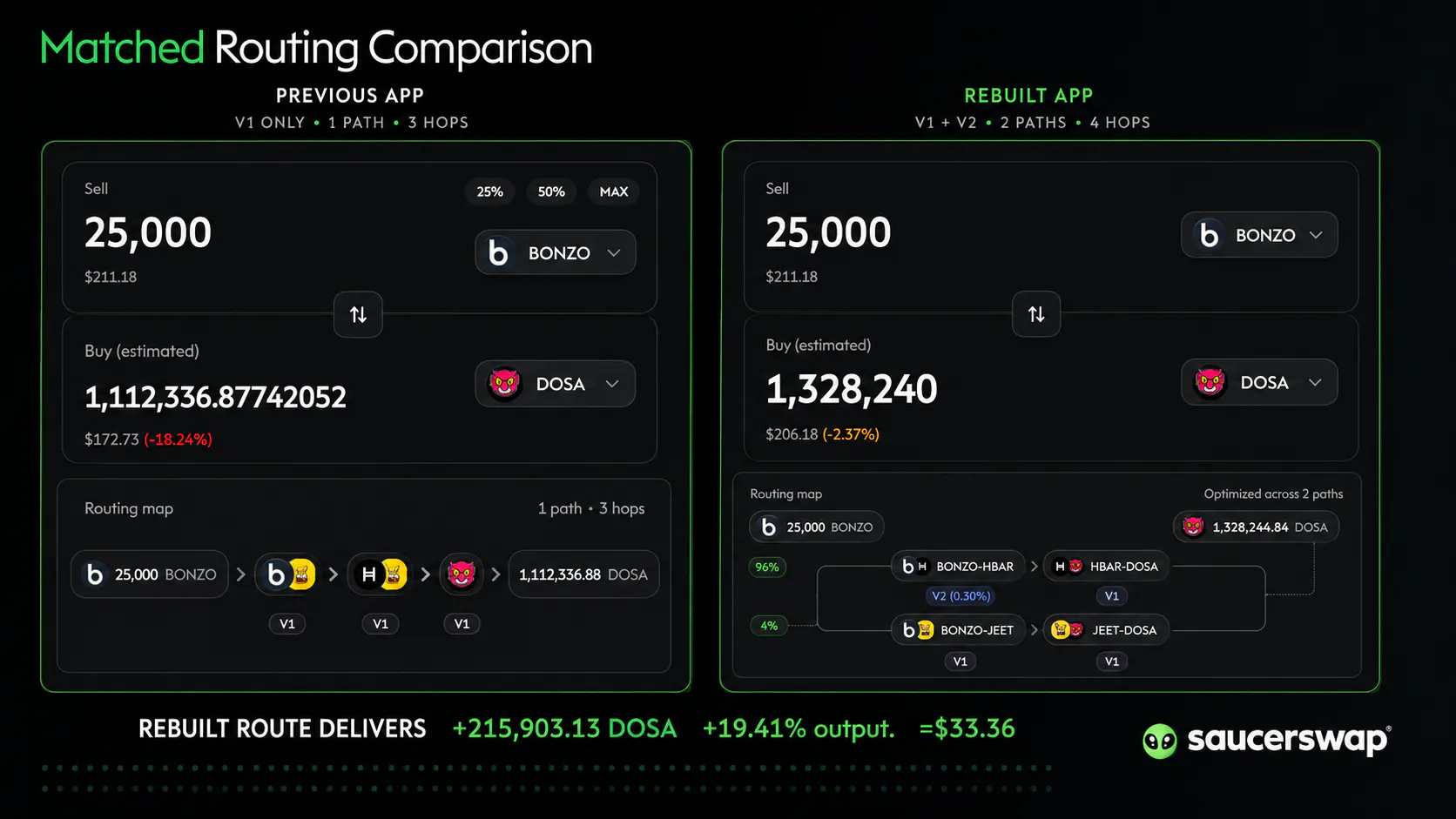
This is where broader routing becomes most consequential. In thinner, fragmented HTS markets, the route between two assets can matter as much as the liquidity in any individual pool. By searching across protocol versions and splitting execution between eligible paths, the rebuilt application can avoid inefficient intermediate legs and preserve substantially more value for the user.
Explore Becomes Queryable Protocol Intelligence
Explore expands from a surface focused primarily on token discovery into a broader protocol-intelligence workspace. Token search and discovery remain, but they now sit alongside Signals, Ask, and Pinned.
Signals brings protocol charts and generated observations together across liquidity, volume, token activity, holders, and staking. Protocol-level charts can open into Ask for further analysis, while signal cards direct users toward the relevant data or action.
Explore Ask turns a supported natural-language question into a structured protocol result. Depending on the question, the response can be a value, chart, or table, accompanied by an editable query and a source receipt showing the underlying data source. Useful analyses can be pinned and revisited in the current browser.
Global search complements this workflow. It handles navigation and product help and can send supported analytical questions into Explore Ask, while Ask remains the dedicated workspace for inspecting, editing, and verifying the result.
Better On-Chain Visibility
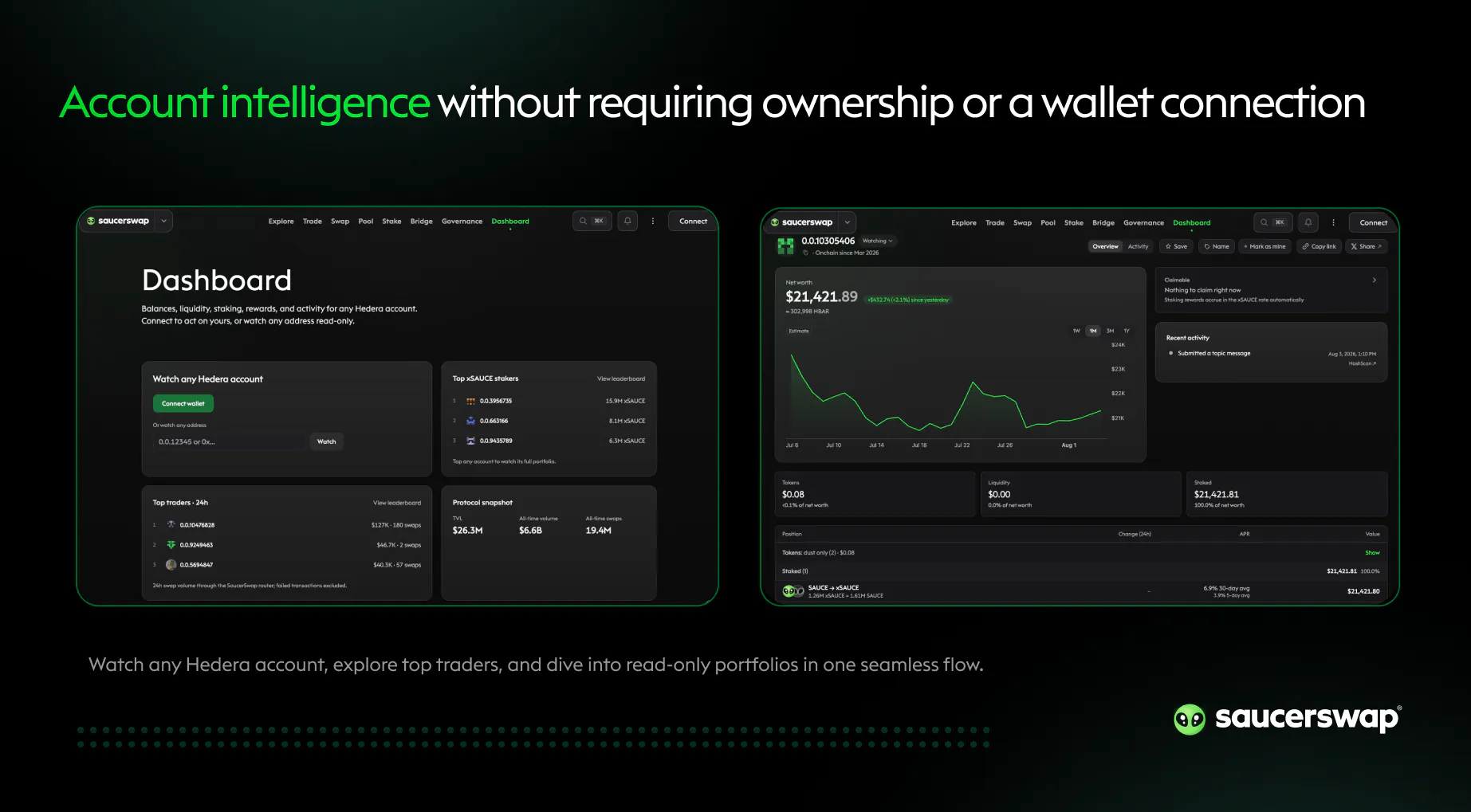
The same emphasis on visibility extends to Dashboard. Users can connect to manage their own account or enter a Hedera account or EVM address to inspect it read-only. Public portfolio URLs make those views directly accessible and shareable.
A new Leaderboard surfaces Top Stakers and Top Holders by current balance, alongside a 24-hour Top Traders view based on observed AMM router swaps. Accounts link into read-only portfolios, adding a useful public-account layer without implying ownership or transaction authority.
Other supporting surfaces have been tightened rather than reinvented. Pool leads with liquidity actions. Stake adds on-chain xSAUCE rate history, verification links, consolidated metrics, V3 fee-discount context, and recent SAUCE inflows to the staking pool around the existing stake and unstake flow. Governance removes the oversized introductory treatment in favor of live proposal state and chronology. Bridge presents its Squid/Axelar route, fees, and delivery expectations more clearly. WHBAR is a new indexed wrap-and-unwrap utility, while the existing Signature Verification tool is now easier to discover through improved navigation and indexing.
A Substantially Lighter Application
The visual overhaul is backed by a substantially leaner frontend. In our August 2 pre-release comparison, 100 controlled cold-load runs covered five representative routes, production and staging, desktop and throttled-mobile scenarios, and five runs per matched case. The redesigned build transferred 29.4% to 92.6% fewer bytes across the ten median comparisons. In a separate capture, uncompressed root HTML fell 63.0%, from 404,824 bytes to 149,670 bytes.
Pool showed the largest network reduction. In the desktop median, transferred data fell from 11.11 MB to 0.82 MB, while network responses fell from 2,377 to 54. The traces also show substantially less global request fan-out across the application.
The refactor also establishes a stronger baseline for accessibility and metadata. The shared page structure includes main landmarks and a keyboard skip link, with more consistent labels for controls. Route-specific titles, descriptions, and canonical metadata are also applied more consistently across the application.
Documentation and Integration, Rebuilt
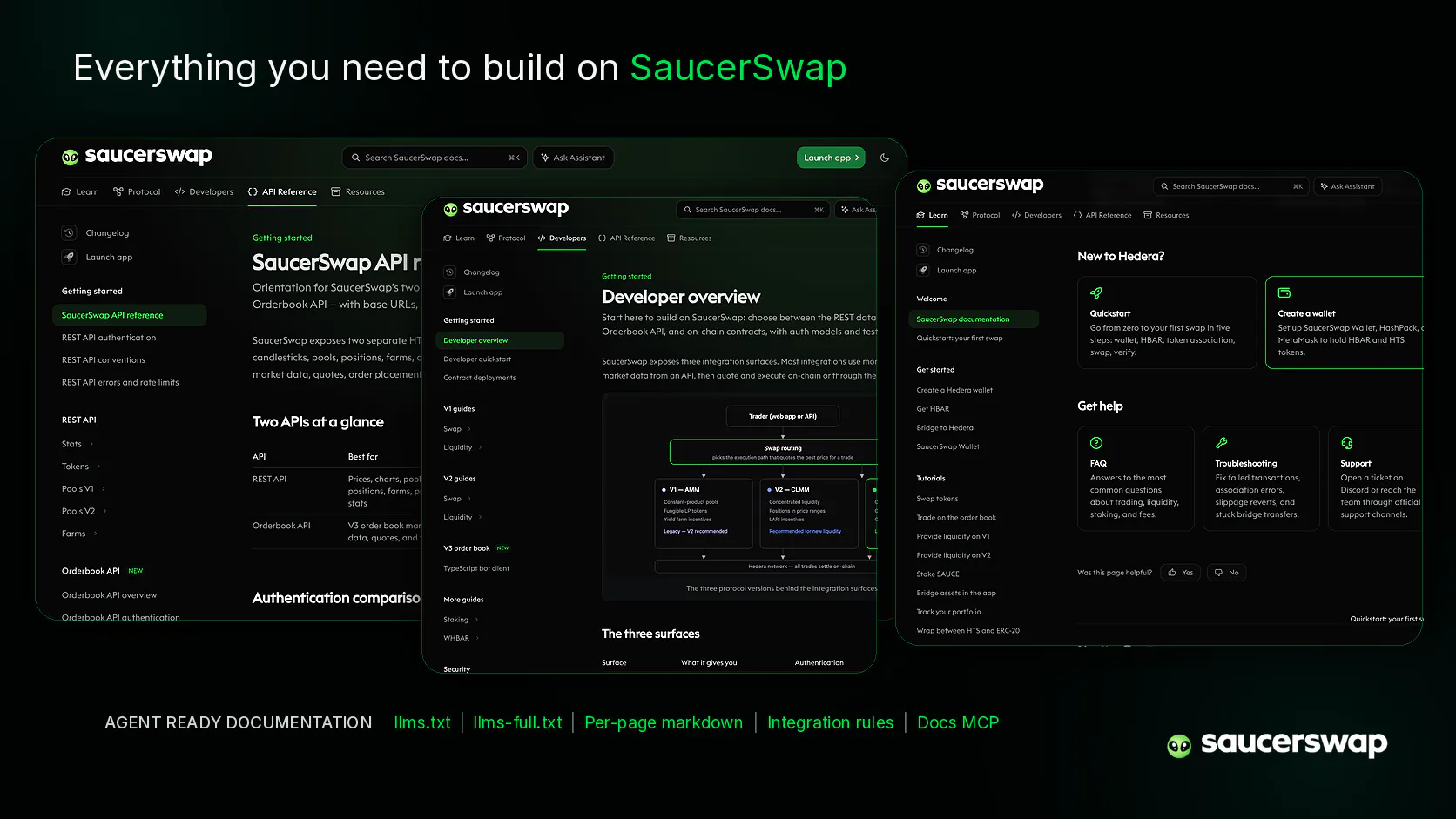
The documentation overhaul was released ahead of this web app and now complements it as the reference layer for the same protocol experience. It contains refreshed protocol and tokenomics material, stronger integration guidance, a generated REST reference, and dedicated coverage of the V3 Order Book API.
For coding tools and agents, the documentation exposes llms.txt, llms-full.txt, per-page Markdown, reusable integration rules, and a hosted MCP server that searches canonical documentation. The MCP is a documentation interface, not a trading endpoint; transaction-authorized activity remains separate and uses the appropriate API or direct integration flow.
SAUCE Tokenomics, Realigned
The broader rollout includes Phase 1 of the ratified HBAR/USD Perpetuals, SAUCE Emission Reduction, and Unified BrewSaucer proposal. This phase halves MasterChef’s emission rate, reducing annual gross SAUCE issuance from approximately 73.3 million to 36.7 million. The maximum supply remains 1 billion SAUCE, with the MasterChef rewards runway estimated to extend by roughly 14 months.
Unified BrewSaucer brings eligible protocol revenue under a common SAUCE buyback and distribution model, after each venue’s required fee allocations. Purchased SAUCE is distributed 40% to xSAUCE, 30% to Development, 10% to burn, and 20% to protocol-owned liquidity and incentives. A separate staking contract uses a MasterChef-style deposit-and-earn model. Its rewards are funded through the BrewSaucer loop, recycling protocol revenue rather than creating additional net inflation for that component.
A portion of newly minted SAUCE that previously went to the staking pool is also redirected to burn—roughly 1 million SAUCE per year at the reduced emission rate. This is an additional burn of newly minted SAUCE, on top of the revenue-funded BrewSaucer buyback-and-burn stream.
Phase 2 activates when HBAR/USD perpetuals launch, separately from the redesigned web app. Perpetuals are actively in development for a Q4 2026 release. The planned market starts with 2× leverage, WHBAR/USDC-backed liquidity, and xSAUCE-based position-fee discounts. Its eligible protocol revenue and GM liquidity rewards join the model when the audited perpetuals infrastructure goes live.
V3 Recalibration Follows the Web App
The V3 recalibration is planned for early next week. It addresses a different layer of the system: calibrated market economics, an upgraded Reactor contract, and a delegated-inventory model for HTS order books, aimed at improving how V3 markets are configured and sustained.
Together, the web app, tokenomics changes, and V3 recalibration improve how users access liquidity, how incentives are distributed, and how order-book markets are sustained.
The new SaucerSwap keeps the familiar core intact while making the protocol easier to navigate, query, and execute against - for users, developers, and agents.


