

Abstract
We replay 7,255,957 historical WHBAR/USDC V2 events against three execution surfaces: the realized V2 concentrated-liquidity AMM (CLMM) baseline, a synthetic V3-style order book, and a hybrid book-plus-V2 backstop that routes residual size to pooled liquidity only when the backstop improves the trader's result. Both V3-style surfaces reduce average study slippage from 19.97 bps on V2 to about 2.26 bps. Pure book delivers the lowest explicit trader fees but leaves more large orders incomplete. Hybrid preserves essentially the same price quality while improving completion: overall full-fill rate rises from 98.21% to 98.95% relative to pure book, and the $25k+ bucket improves from 42.16% to 65.11%. Exact fee reconstruction shows that explicit trader fees fall from $5.89 million on V2 to $4.62 million on pure book and $4.66 million on hybrid, with further reductions in the modeled tier-2 xSAUCE case. Provider-side results are mixed: rebate-only comparisons understate book-maker economics because the book leg captures $1.82 million of gross spread, yet the aggregate symmetric provider-economics proxy still favors V2 overall, although the pure-book leg leads in the $25k+ bucket. Overall, for a core liquid pair, book-first execution with a conditional pool backstop is the strongest design in the study.
Introduction
SaucerSwap V3 is built around a different market structure from V2. V2 is the concentrated-liquidity AMM baseline used in this study. V3 introduces a central limit order book with off-chain matching, atomic settlement on Hedera L1, maker/taker pricing, and the ability to tap V1/V2 pools as backstop liquidity when the book alone cannot satisfy an order at acceptable terms. The practical question is whether that structure improves execution where SaucerSwap is already strongest today: a liquid core market with real historical flow.
This study addresses that question on WHBAR/USDC. The replay compares three lanes: the realized V2 baseline, a pure synthetic order book, and a hybrid design that first uses the book and then routes residual size to historical V2 when the backstop passes the study's admissibility rule. The results support a clear but qualified conclusion. Both V3-style lanes materially improve trader price quality relative to V2. The more consequential distinction is between pure book and hybrid. Pure book captures most of the price improvement and delivers the lowest explicit fee surface, but hybrid better balances price quality with completion once larger tickets are taken seriously.
1.1. Study contributions
- It compares pool-only, book-only, and hybrid execution surfaces on 7,255,957 historical WHBAR/USDC V2 events.
- It makes the main trade-off explicit: V3-style design sharply improves price quality, hybrid materially improves completion relative to pure book in the largest-ticket bucket, and spread-capture plus symmetric loss proxies reveal more than rebate-only fee tables can show.
Market structure and study design
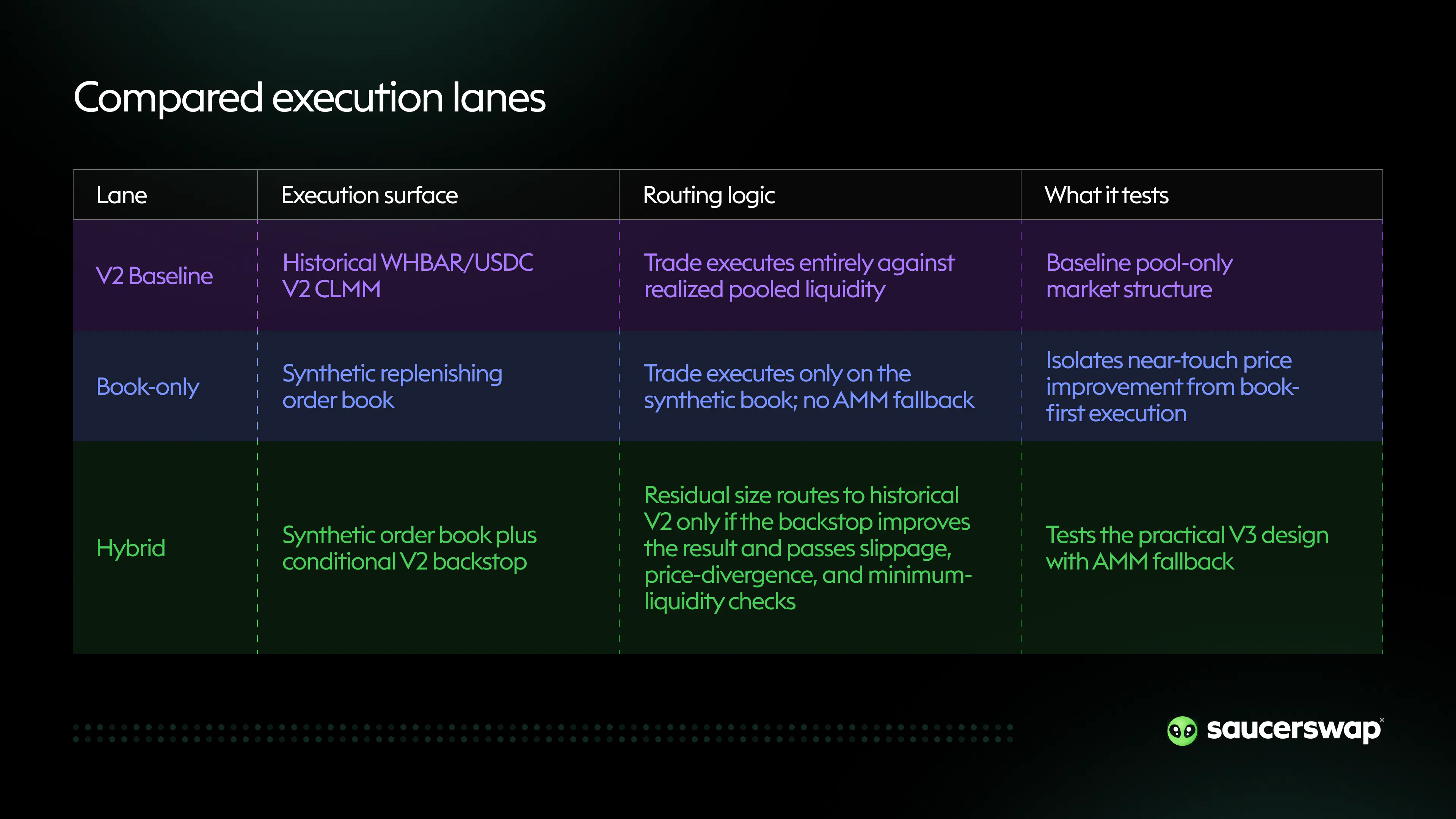
The study evaluates a historical AMM baseline against two V3-style execution surfaces. Table 1 summarizes what each lane represents.hh
2.1. Replay data, synthetic book, and metrics
The replay covers 7,255,957 historical WHBAR/USDC V2 events: 3,770,999 buys and 3,484,958 sells. The synthetic book is a six-level replenishing grid around the study reference price with levels at 2, 4, 8, 16, 32, and 64 bps, weights of 1/1/2/3/5/8, and total grid liquidity of $20,000. The pair choice matters because this is already a liquid core market; the note is not a blanket test for long-tail assets.
The main execution metrics are average study slippage, full-fill rate, average completion, and remainder. Average study slippage measures deviation from the study reference price in basis points. Full-fill rate is the share of replay units completed in full. Average completion is the average share of requested size that gets filled. Remainder is total unfilled HBAR. The fee layer then reconstructs trader fees, maker rebates, V2 LP accrual, and protocol earnings from filled notional under the locked study fee contract. A further provider layer adds gross spread capture and a next-event adverse-selection haircut to form a more symmetric provider-economics proxy.
Primary results
3.1. Headline execution quality
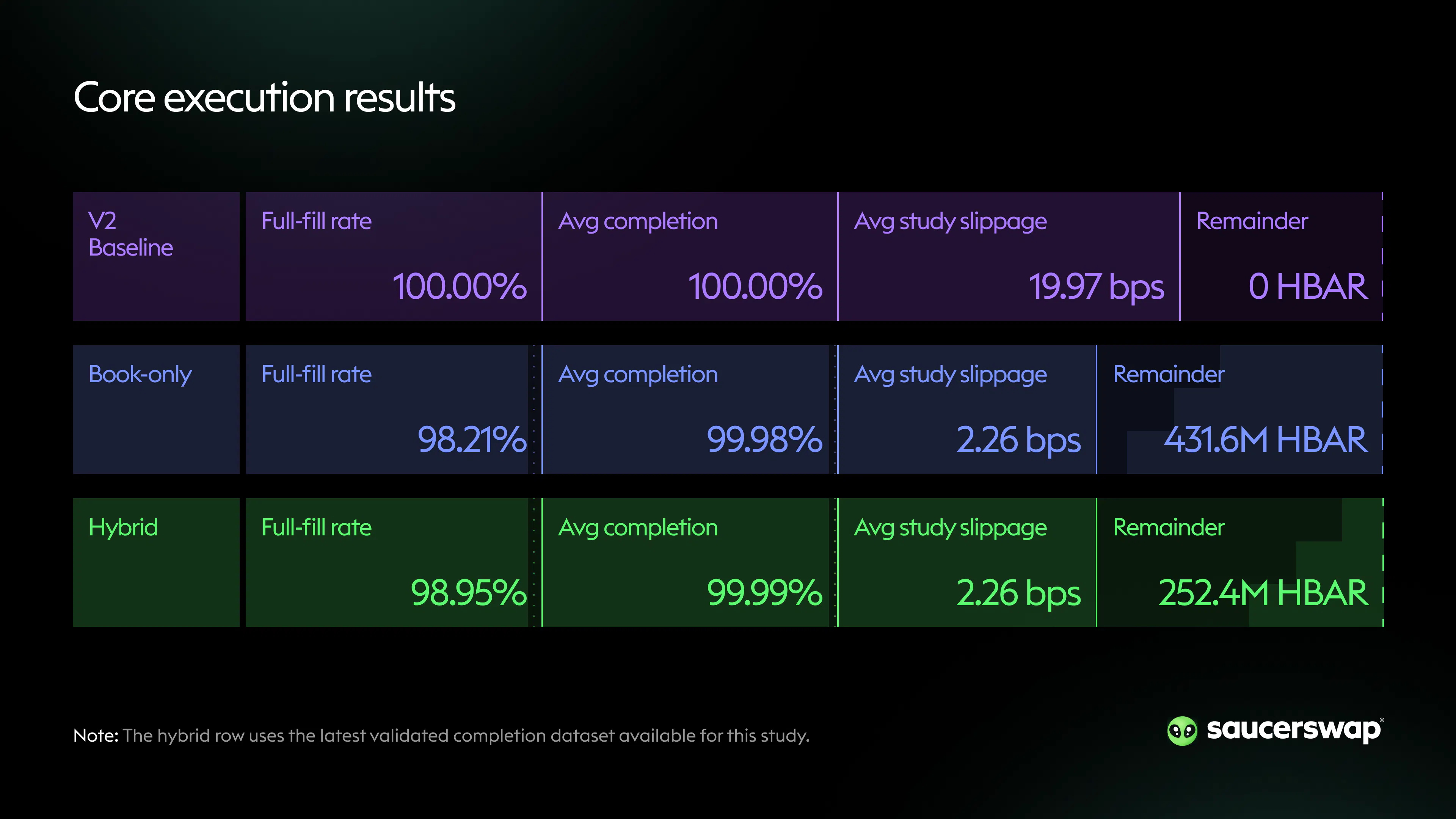
Table 2 summarizes the main execution outcomes. V2 provides a 100% completion baseline because the historical replay follows realized pooled execution. Both V3-style surfaces cut average study slippage from 19.97 bps to about 2.26 bps. On price quality alone, pure book and hybrid are effectively tied.
The difference emerges in completion. Hybrid lifts full-fill rate from 98.21% to 98.95% relative to pure book, raises average completion from 99.98% to 99.99%, and reduces remainder by 178.4 million HBAR, roughly a 41% reduction. The study's secondary cost framing points the same way: implied study-slippage cost per $1 million filled falls from $2,432 on V2 to $473 on pure book and $497 on hybrid.
External comparison note. Lambdaplex reported 15.47 bps average AMM slippage and 2.82 bps grid-strategy slippage in a similar WHBAR/USDC study. Using the separate AMM pre-trade spot gross slippage parity proxy in our harness, the V2 baseline also lands at 15.47 bps. On that same proxy surface, our V3-style lanes land at 2.26 bps for book-only and 2.26 bps for hybrid. This is a denominator check rather than a fully normalized cross-study benchmark.
3.2. Large-order stress case
The $25k+ requested-notional bucket is the clearest stress test in the replay because limited near-touch depth in the synthetic book becomes binding at larger clip sizes.
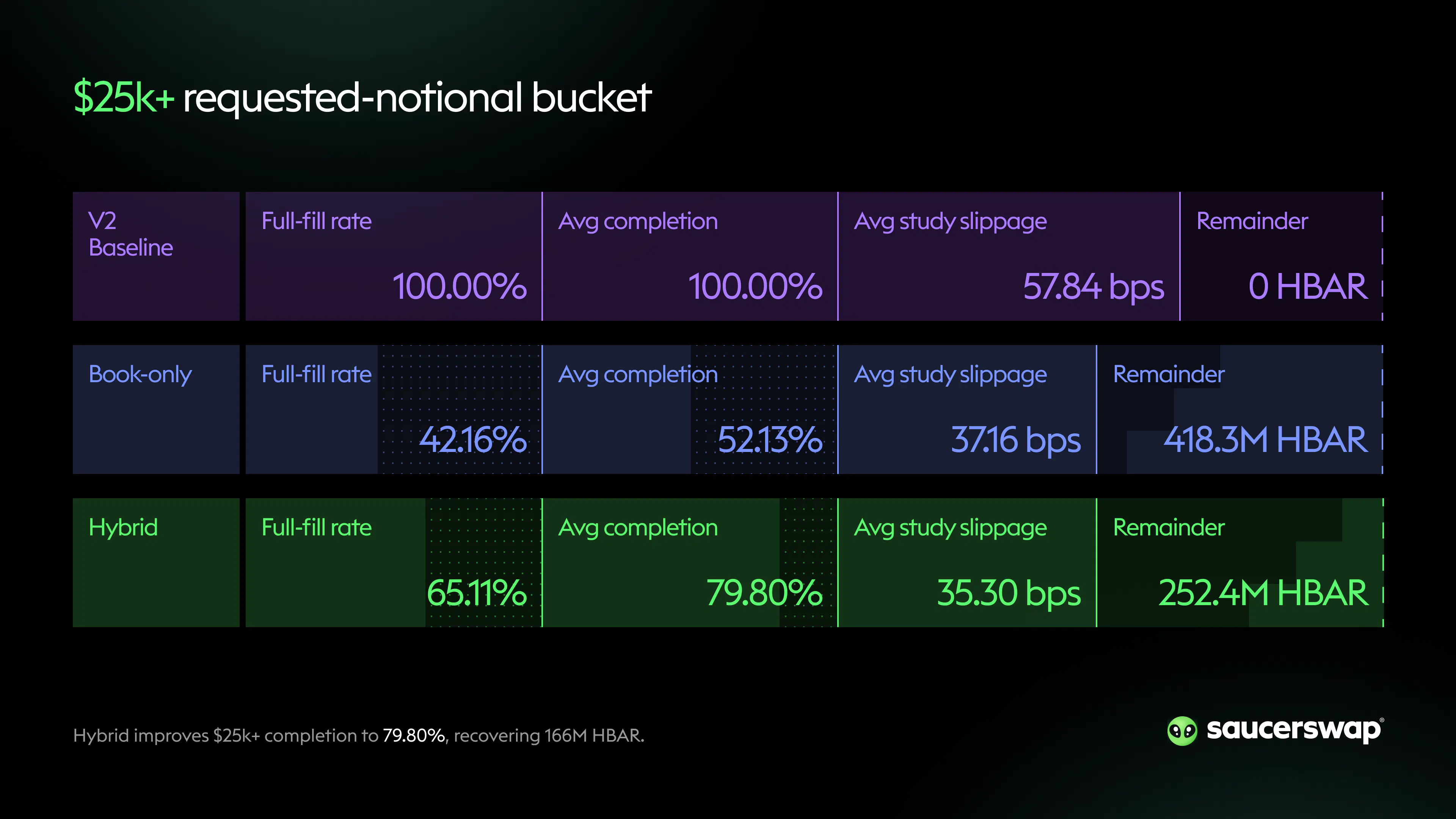
Pure book still improves on V2 in price terms, but the completion gap is too large to ignore: only 42.16% of these replay units are fully completed and average completion is 52.13%. Hybrid materially closes that gap. Full-fill rate rises to 65.11%, average completion to 79.80%, and remainder falls by roughly 166 million HBAR relative to pure book, while slippage remains well below the 57.84 bps V2 baseline.
Relative to the earlier hybrid completion dataset, the updated dataset improves the $25k+ bucket from 59.84% to 65.11% full-fill and from 73.94% to 79.80% average completion, while lowering remainder from 290.5 million to 252.4 million HBAR. Average slippage rises modestly from 34.04 to 35.30 bps. The trade-off is straightforward: a small loss on price buys a larger gain in completion.
3.3. Explicit trader fees
Table 4 reports the study's exact fee reconstruction on the fee dataset. V2 is the most expensive lane for traders on this surface.
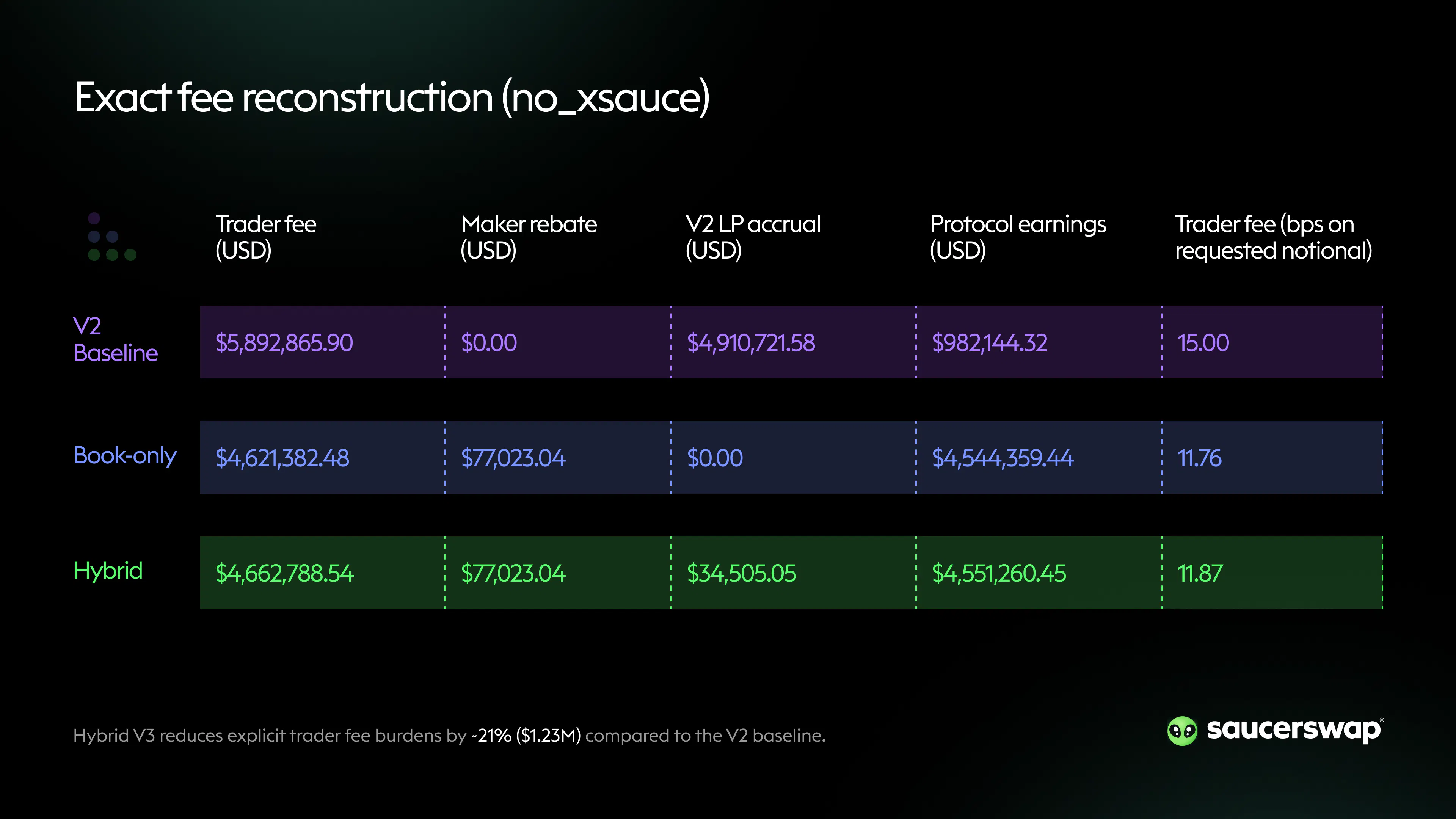
Pure book lowers explicit trader fees by about 21.6% versus V2. Hybrid lowers them by about 20.9%. The small gap between pure book and hybrid comes from residual flow that lands on the V2 backstop and inherits V2 fees.
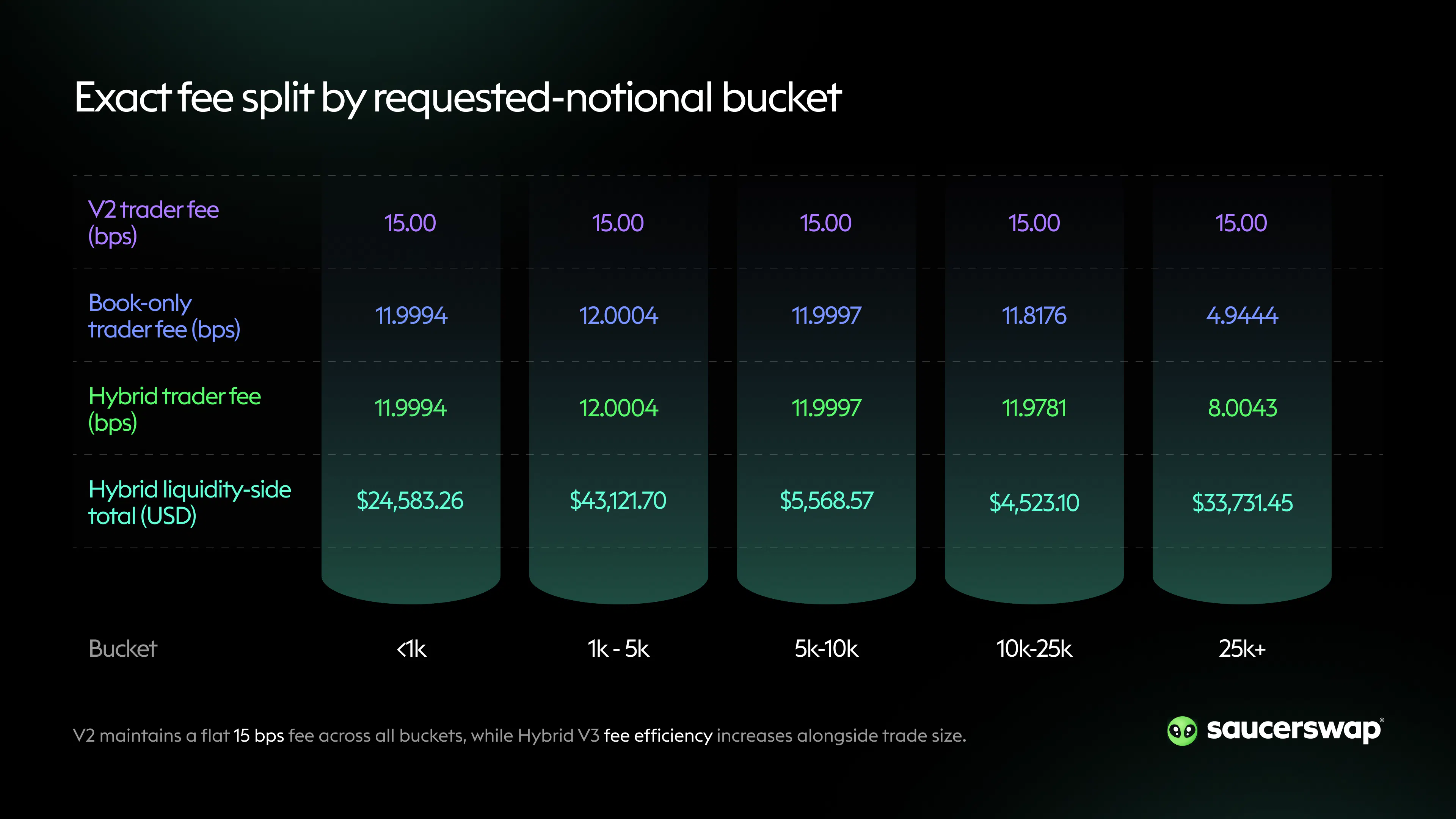
Below $10k, pure book and hybrid are effectively identical on fee rate, which suggests the synthetic book already absorbs most of that flow. The difference opens in larger tickets. In the $25k+ bucket, trader fees are 4.94 bps on pure book, 8.00 bps on hybrid, and 15.00 bps on V2. These are effective explicit trader-fee burdens normalized by requested notional, not the raw V3 book fee schedule or a trader fee net of maker rebates. The raw V3 book schedule remains 12.0 bps taker / -0.20 bps maker; the lower bucket figures arise because explicit fees are charged on filled notional while the headline fee rollups are normalized by requested notional, so incomplete pure-book fills and hybrid routing pull the effective bucket average below the raw taker fee. Hybrid therefore remains materially cheaper than V2 while completing more of the hardest flow than pure book. The modeled tier-2 xSAUCE case pushes trader fees lower still, reducing the totals to $4.16 million on pure book and $4.20 million on hybrid.
Provider economics
Liquidity compensation is expressed differently across V2 and the V3-style lanes. In V2, it appears largely as explicit LP fee accrual. In a book-first market, explicit maker rebate is only one part of the story; filled resting quotes also earn spread capture. Table 5 therefore reports the study's aggregate symmetric provider-economics proxy rather than a rebate-only comparison.
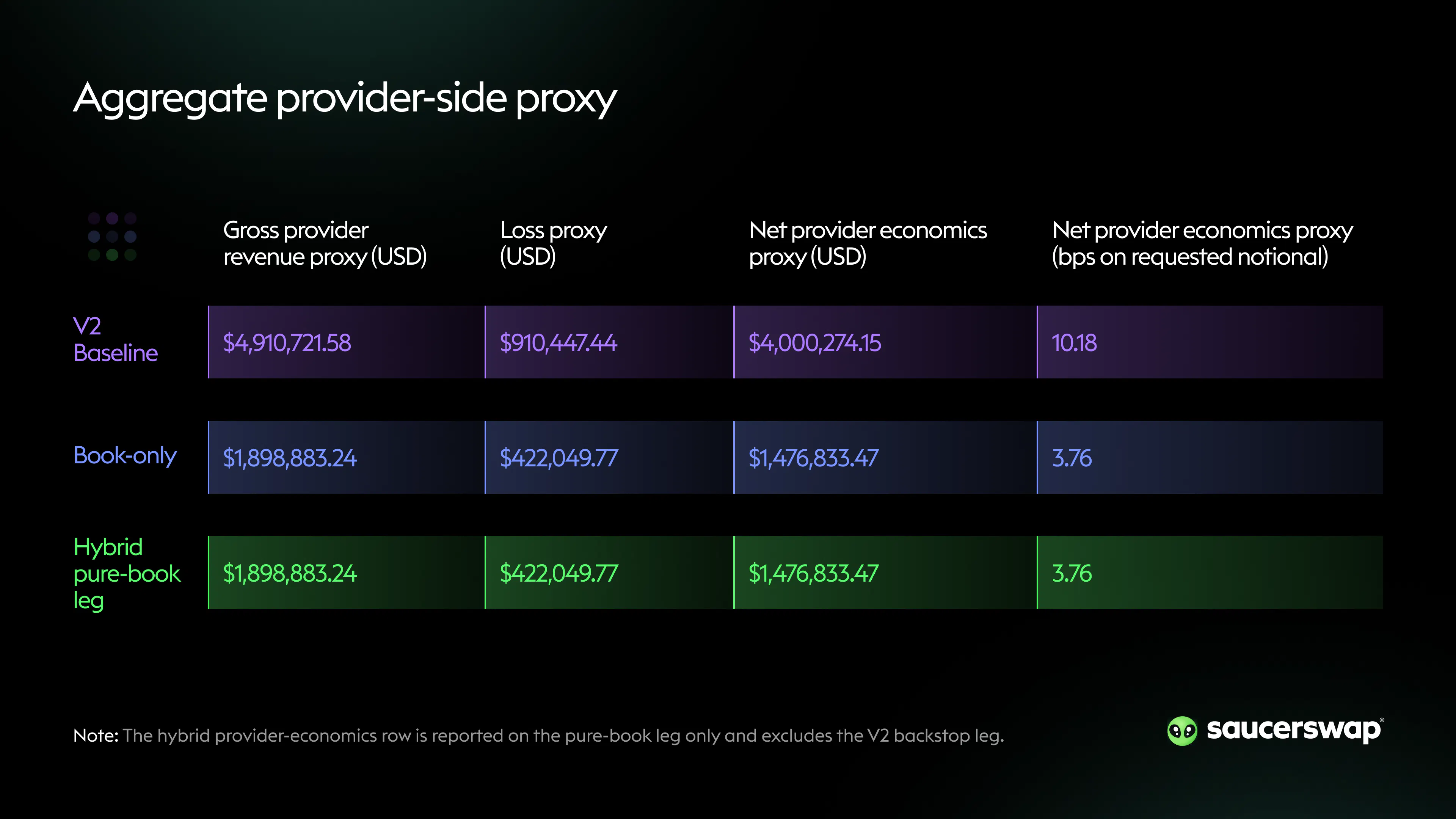
On this proxy, V2 still has the larger aggregate provider-side surface. At the same time, a rebate-only reading materially understates order-book maker economics. The pure-book leg generates $1.82 million of gross spread capture against only $77,023 of explicit maker rebates.
The size gradient is especially important. Gross spread capture rises from 2.00 bps in the <$1k bucket to 37.09 bps in the $25k+ bucket. In that $25k+ bucket, the pure-book leg's net provider-economics proxy reaches 14.93 bps on requested notional versus 9.32 bps for V2. The aggregate provider comparison thus compresses two different monetization regimes into one headline number: V2 monetizes broad passive flow through explicit LP fees, while the order book monetizes more selectively and relies much more on spread capture than on rebates.
Interpretation of results
The replay's pattern follows the underlying market designs. An AMM offers continuous pooled liquidity, but every trade walks the curve. A book-first design can quote tighter near the market when there is active resting depth at those prices. That is the structural reason both V3-style lanes deliver much lower average study slippage than V2 on the same historical flow.
The large-order trade-off follows from the same logic. A finite replenishing book can be very efficient near the touch and still run out of nearby depth on larger clips. Hybrid improves the result because it does not force the book to do all the work. It lets the book handle the flow it can absorb efficiently, then routes residual size to V1/V2 only when the blended execution still benefits the trader and passes the relevant routing checks.
The fee outcomes are consistent with the locked pair-specific fee contract used in the study. On this pair model, V2 charges 15.0 bps to traders, while the V3 book charges 12.0 bps to takers and pays a 0.20 bps maker rebate by default. In the study’s tier-2 xSAUCE case, the tier is modeled as a 10% modifier to the V3 fee schedule: taker cost falls from 12.0 to 10.8 bps, the negative maker fee becomes more negative from -0.20 to -0.22 bps, and the rebate clamp does not bind. This design helps explain why explicit liquidity-side transfers are much smaller in the V3-style lanes even as broader maker monetization becomes more visible once spread capture is included.
Limitations and scope
Completion profile. V2 is the only lane that fully completes the entire replay. Hybrid narrows the gap enough to change the overall ranking, but it does not erase that difference.
Mechanical fee advantage. Pure book's fee advantage in the largest bucket is partly mechanical because it completes less of the hardest flow. Fee comparisons therefore need to be read alongside fill rate and average completion, not in isolation.
Provider modeling. The provider comparison remains a proxy. It improves materially on a rebate-only reading, but it still does not model inventory carry, queue position, quote persistence, capital efficiency, or longer-horizon adverse selection in full.
Dataset mismatch. The latest hybrid execution dataset and the exact fee-reconstruction dataset are not identical. Both surfaces point to the same overall ranking, but the execution and exact fee tables should not be read as if they were generated from one identical dataset.
Scope. This is a pair-specific and launch-specific result. It is evidence about a liquid core market, not a blanket conclusion for every asset and liquidity regime SaucerSwap supports.
Practical implications
For traders, hybrid is the strongest practical interpretation of V3. It preserves the slippage improvement that makes the book attractive in the first place and recovers a meaningful share of the completion that pure book leaves behind on larger tickets.
For active market makers, the center of gravity shifts from passive AMM exposure to order-book workflows: market and limit orders, post-only behavior, time-in-force controls, signed intents, fast cancellation, and order-history tooling. The study suggests that spread capture, not rebate alone, is the central economic variable.
For long-tail assets and passive users, V1/2 still have a clear role. The study does not support a 'replace everything with the book' interpretation. It supports a targeted one: core markets benefit from book-first execution, while AMMs remain valuable both as standalone venues and as fallback liquidity.
For the DAO and token holders, the result still matters because V3 changes the fee engine as well as the execution engine. But detailed forward launch-economics projections are outside the scope of this note, which is focused on replayed trader outcomes and the market-structure trade-offs behind them.
Conclusion
On historical WHBAR/USDC flow, a V3-style execution surface produces materially better price quality than the V2 baseline. Pure book captures most of that gain on price and posts the lowest explicit fee surface, but hybrid is the stronger overall design because it preserves the price improvement while recovering more completion, especially where order size makes book depth the binding constraint.
The provider-side story is more mixed. Even so, the evidence is strongest on the dimensions most relevant to trader outcomes: execution quality, explicit trader cost, and the value of a conditional pool backstop. On this core market, those factors favor hybrid V3 over the V2 baseline.
Appendix. Supplementary tables
The appendix compacts the remaining material results. Execution tables use the latest hybrid execution dataset available to the study. Exact fee tables use the exact fee-reconstruction basis.
A1. Exact fee split by requested-notional bucket (no_xsauce)
The fee divergence between pure book and hybrid is concentrated in larger trades. Below $10k, the two V3-style lanes are essentially indistinguishable on this basis.
A2. Aggregate xSAUCE sensitivity (exact fee basis)
The tier-2 xSAUCE case changes fee allocation, not the execution path. Fill rate, completion, slippage, and spread capture stay the same on this model.
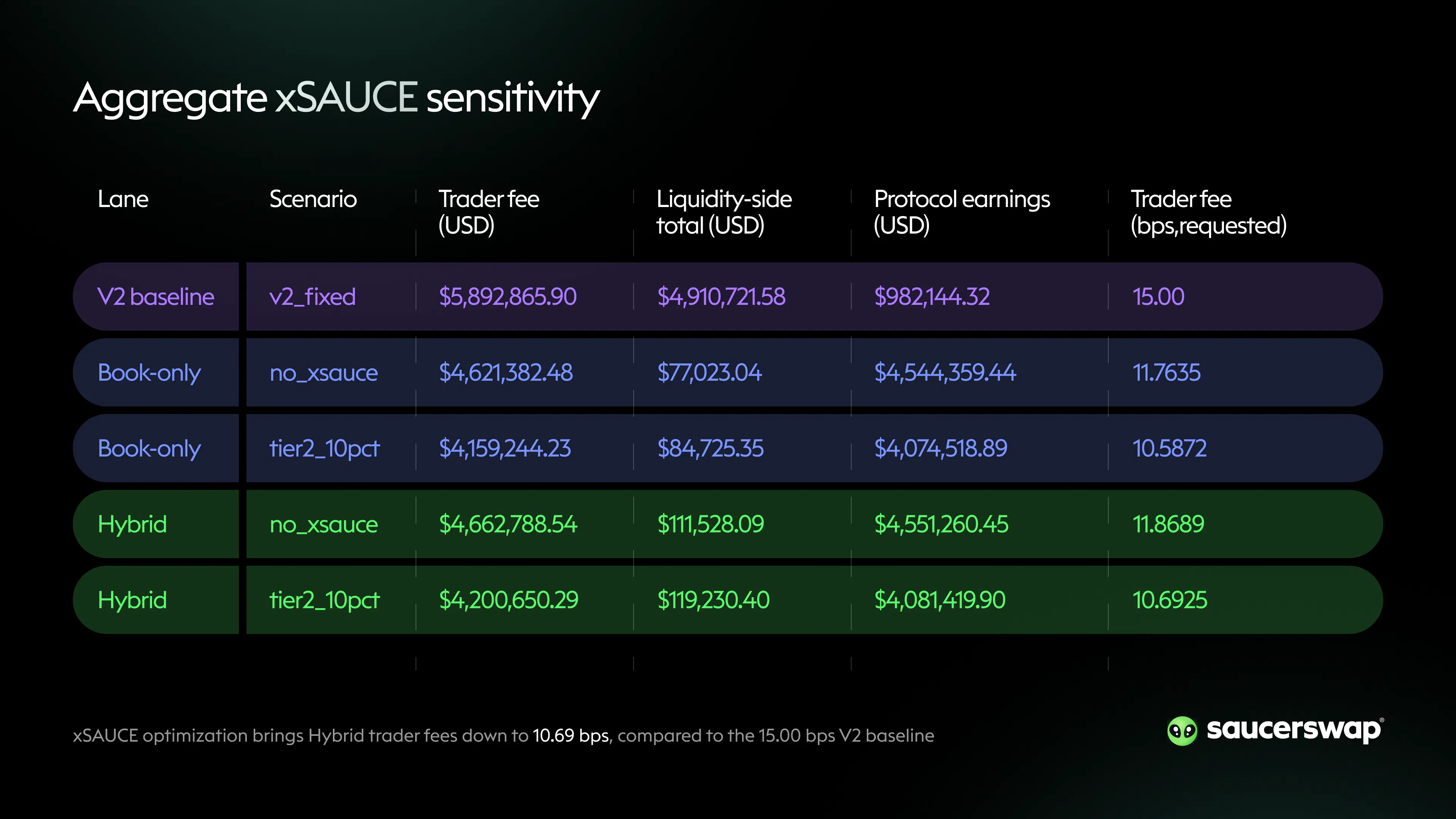
Relative to the default no-xSAUCE schedule, the tier-2 case lowers trader fees by about $462k in both V3-style lanes and increases the maker-side transfer modestly.
A3. Gross spread capture and provider stress case
Gross spread capture is reported on the book leg only. The provider-economics stress case uses the study's symmetric loss proxy.
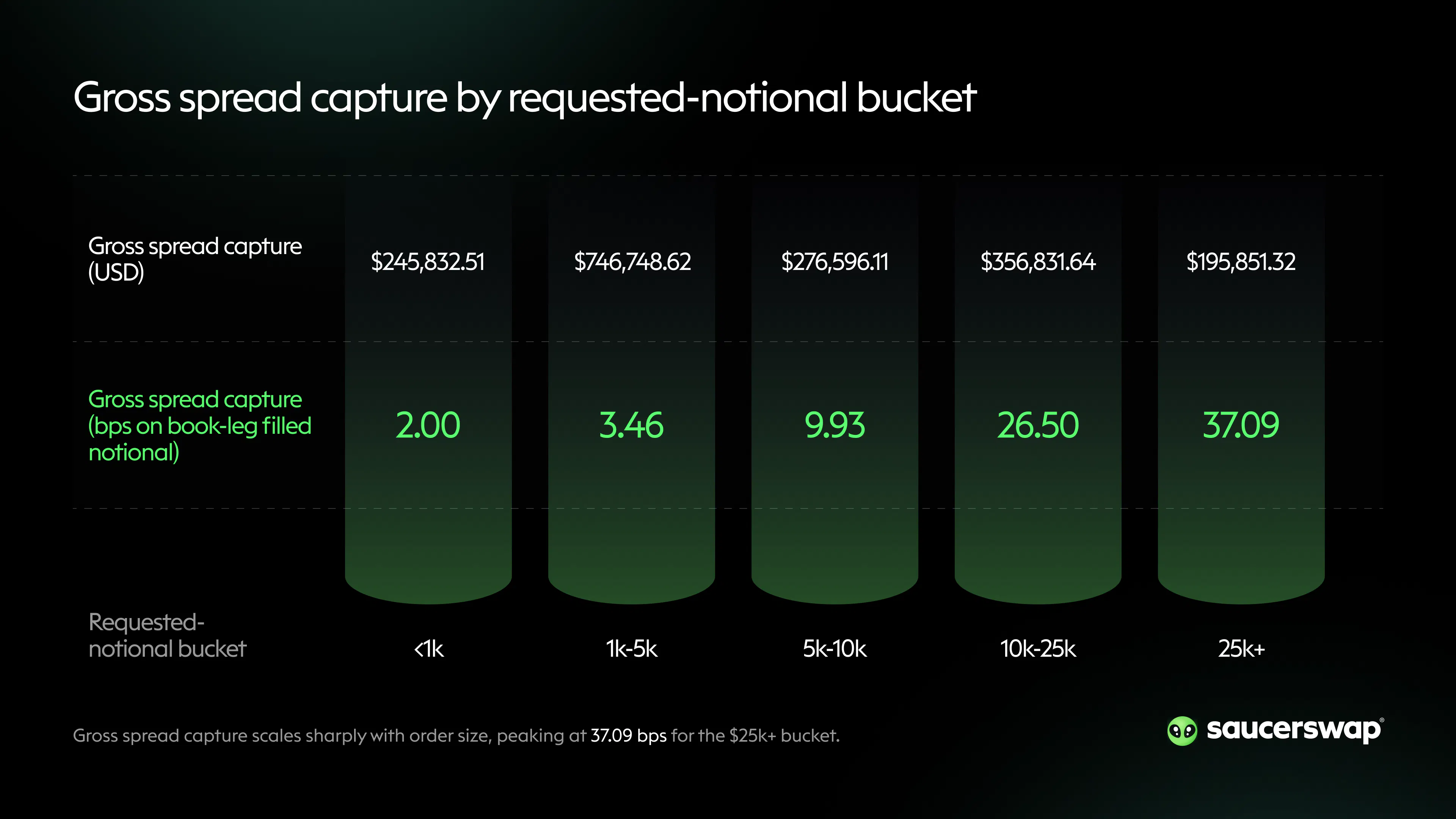
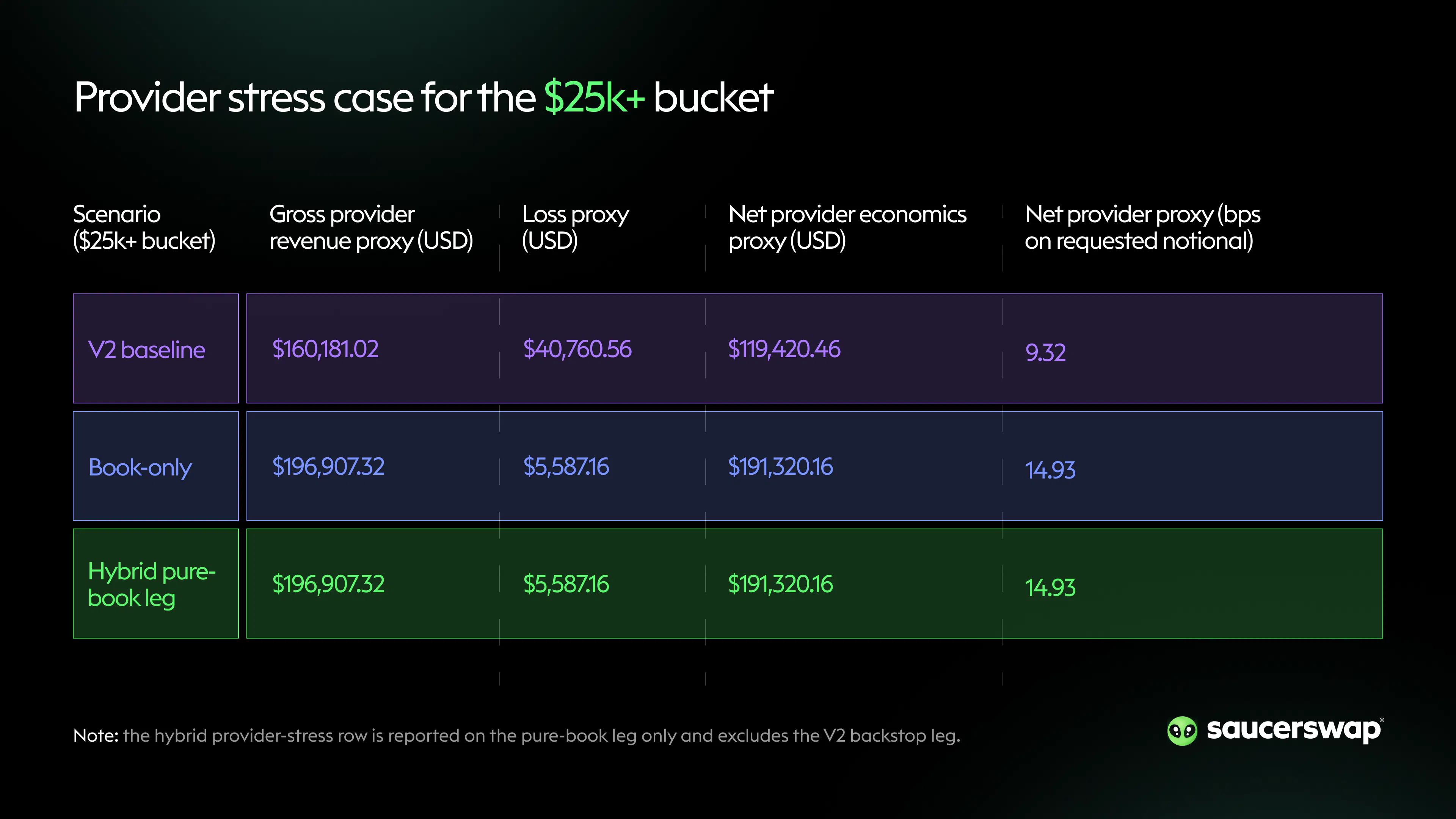
Spread capture rises steeply with order size, and in the $25k+ bucket the pure-book leg's net provider proxy exceeds the V2 figure. That is the clearest evidence in the study against a rebate-only reading of maker economics.
