


In a full-range automated market maker (AMM), DeFi liquidity providers spread their capital across all possible price levels, and most of their funds remain underutilized. Traders also have less liquidity at the actual market price and experience higher slippage.
Concentrated liquidity (CL) lets providers focus their capital within active trading ranges, which results in less slippage. In this article, we break down how CL works and how providers and traders can benefit from it.
Overview of Concentrated Liquidity
In the case of full-range AMMs, liquidity is allocated uniformly across a theoretically infinite price curve. This is often inefficient when most trades happen within a relatively narrow price range, since the capital may be underutilized at price levels the market is unlikely to reach.
This is why liquidity providers on decentralized exchanges (DEXs) often opt for a more capital-efficient model: concentrated liquidity, which, in turn, can provide traders with deeper liquidity and more stable pricing around the active market price. It’s a model that allows providers to allocate liquidity within a specific custom price range, thereby boosting their capital efficiency.
Within this model, providers often need to take a more hands-on approach and monitor their positions more closely. This is because if the market level shifts outside the given range, the position becomes inactive and stops earning fees until the provider adjusts their parameters. Yet, this extra oversight may be worth it, as CL market makers (CLMMs) offer the potential for higher fee earnings.
In addition, DeFi traders can leverage the market depth generated by the CL model. Since capital is concentrated around the current market price, there is greater capital available at the price level where trades occur, which allows traders to buy or sell assets with reduced market impact. The result is a decrease in slippage. In a market with concentrated capital, traders are more likely to achieve their expected execution price, even when placing larger orders.
Price Curve and Capital-Efficient Design
The mathematical logic of each AMM is defined by the constant product formula: x · y = k, where x and y represent the quantities of the two assets in a liquidity pool, while k is a constant value.
The primary distinction between full-range AMMs and CLMMs is the interval over which liquidity is made available:
- In a traditional AMM, the x · y = k equation produces a curve that approaches but never intersects the axis. To support trading across this infinite range, funds must be distributed very thinly, which leaves much of the capital idle at prices the market is unlikely to reach.
- CLMMs address the problem of idle capital by allowing liquidity providers to allocate capital within a specific range. Yet, in this case, providers accept that their capital will become “inactive” and stop earning fees while the price remains outside their selected range.
Now, when capital is concentrated precisely where trades occur, significantly less liquidity can provide comparable depth and potentially generate fees comparable to those from much larger positions in traditional AMMs. This, in turn, creates a “thicker” market for traders and allows larger orders to be executed with reduced slippage.
Liquidity Pool Structure and Pool Creation
Differences in the use of capital directly affect the structure of liquidity pools in both models. In a conventional AMM, the pool operates as a single bucket in which all deposited tokens are mixed into shared reserves.
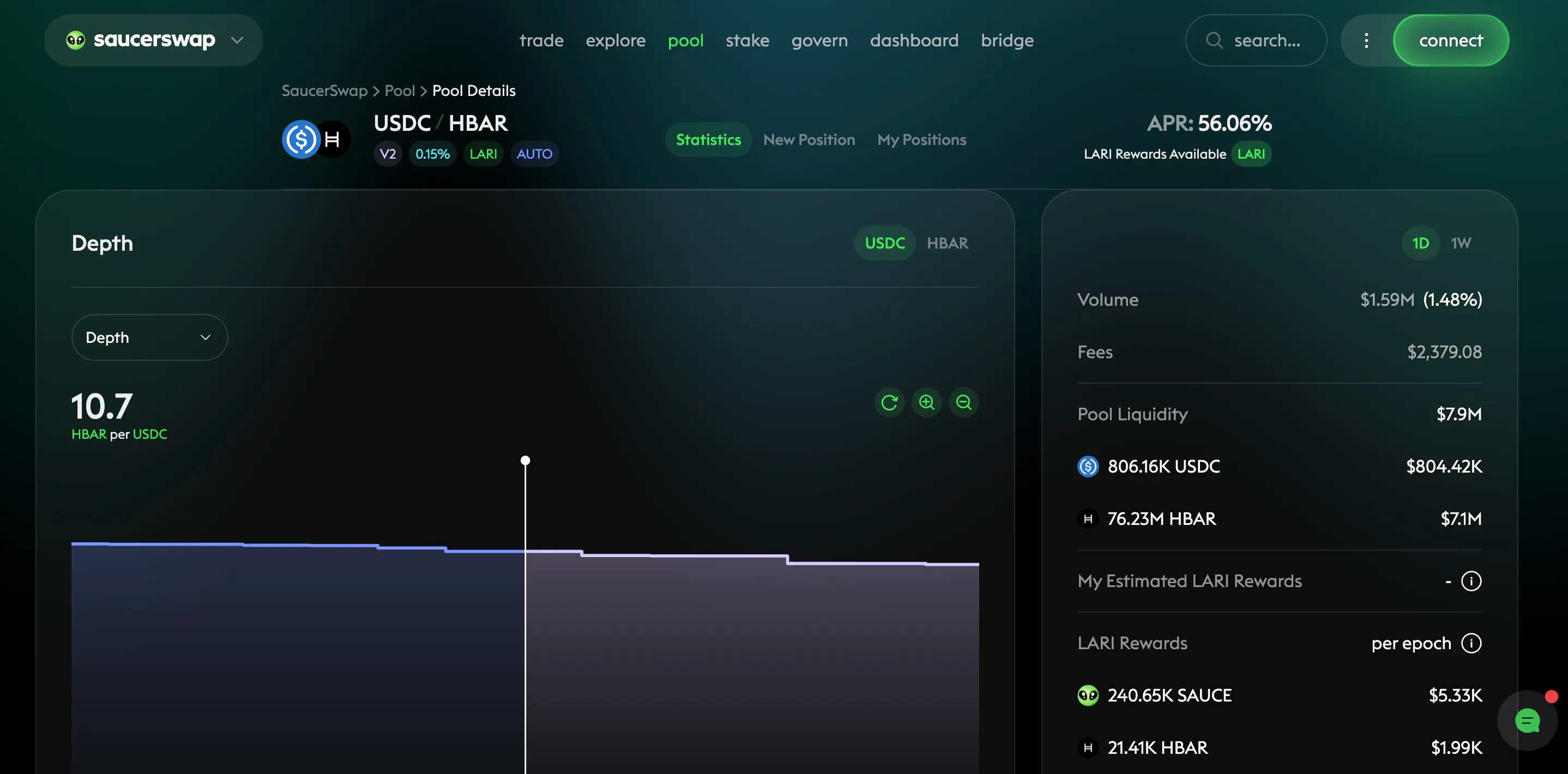
When it comes to CLMMs, it’s still a single smart contract (one pool), but capital is distributed more segmentally here. The curve is divided into discrete points called ticks, and liquidity is allocated between selected tick boundaries. When participants provide liquidity, they deposit reserves into a specified range defined by ticks.
When establishing a CL pool, several parameters must be configured, such as asset pair, fee tier, and tick spacing. Further, we provide a broader checklist for pool creators.
Ticks, Active Tick, and Active Liquidity
To determine the exact zones where the capital will be deployed, providers select an upper tick and a lower tick, which together define the entire price range with active liquidity. As trading occurs, the price moves incrementally across ticks.
Each time the price crosses the tick boundary (this is called tick crossing), positions whose ranges now include the current level become active, while others become inactive. That’s why keeping track of price movements is essential for adjusting their price ranges and remaining active in the market.
Price Range and Tick Boundaries
A provider can either place their liquidity closer to the current price to maximize fee generation or spread it across a wider range to capture fees from larger price movements.
Additionally, as we’ve mentioned, they can also reposition their liquidity in response to price changes. When the price moves, they might adjust their liquidity to a range closer to an active trading zone to keep earning trading fees.
Furthermore, liquidity positions can function similarly to limit orders. The provider can place liquidity only above or below the current price. Once the market enters this range, liquidity is used for trades, and the provider's tokens are gradually converted into the other asset. In this scenario, providers essentially accumulate one asset or the other based on the market price levels they have specified.
Swap Mechanics: Price Impact and Swap Amounts
Now, when it comes to how traders benefit from CL, it primarily depends on the size of the swap. The swap is executed against liquidity at the current price, and its size determines how much liquidity is used. If the trade is small relative to the available liquidity, it can be completed with minimal price movement. If it’s larger, it may start pushing the price toward the next tick boundary.
Execution also depends on how far the trade moves across price ranges. The more ranges it moves through, the greater the price impact and the worse the final execution price becomes. Therefore, if liquidity is dense near the current price, even larger trades can be executed efficiently. If liquidity is thin or uneven, the trade may move the price more quickly, which increases slippage.
Providers of liquidity earn fees only from specific price ranges where their liquidity is active. As the trade moves across ranges, it interacts with different portions of liquidity, and fees are distributed to providers whose liquidity is used at each step.
Implementation Checklist for Pool Creators
Setting up a CL pool involves several key decisions that directly affect how efficiently liquidity is utilized and how attractive the pool is to providers and traders. When it comes to pool creation, creators typically follow these steps:
- Select the token pair. Pick tokens with high organic demand. More trading volume means more fees.
- Note the fee tier. For example, SaucerSwap V1 liquidity pools operate under a fixed 0.3% fee tier. There's no selection to make here — it applies uniformly across all V1 pools. On SaucerSwap V2 (CLMM), however, liquidity providers can choose from four fee tiers — 0.05%, 0.15%, 0.30%, and 1% — based on the pair's volatility profile. V2 is currently permissioned, though a permissionless model is planned for the future.
- Choose the appropriate fee tier. It's a choice that involves some risk. Creators should opt for lower fees if the involved tokens are more stable than average. But if the tokens in a trading pair are more volatile, it’s best to choose higher fees.
- Define the price range. Providers choose the range within which their liquidity will be active. A tighter range can generate more fees when the market stays within it, but requires closer monitoring and more active management.
- Set the initial price. It must reflect the current market price as closely as possible. A significant divergence will be corrected, which typically comes at the pool creator's expense.
- Add initial liquidity. Both tokens in the pair need to be deposited upfront. This initial deposit is what enables the first trades to go through.
- Make the pool discoverable. Creators should ensure the liquidity pool is visible. Without this, potential liquidity providers and traders simply won't find it.
Operational Steps: From Pool Creation to Position Management
Once the pool is created, providers step in. The first part is deciding on the range. A good starting point is to center liquidity around the current price with enough range to cover expected volatility.
Providers should also consider market behavior when adding liquidity. In a market with a stable price and predictable price movement, a tighter range is sufficient. A wider range must be provided in a market with volatile assets to avoid frequent repositioning.
If there’s a need for repositioning, it’s sometimes best not to adjust the position until it’s clear that the price has moved outside the current range. This is because continuously adjusting the range could result in lower returns due to transaction fees and rebalancing costs, particularly on Ethereum. But on platforms like SaucerSwap, built on Hedera, active management is much more cost-effective, thanks to much lower fees (usually fractions of a cent).
Finally, as providers collect fees, they should pay attention to how much they’re earning, as it reflects how effectively their liquidity is placed. If a position generates low fees, it may be poorly positioned relative to the trading activity, which suggests that the range needs to be adjusted.
Conclusion
Although concentrated liquidity requires a bit more effort and involvement than full-range AMMs, it is also where the edge lies. Providers can concentrate their capital where actual trading occurs, which allows them to boost their capital efficiency.
Traders, in turn, benefit from larger liquidity and lower market impact. Overall, CL is about smart, more intentional capital deployment.
And for those willing to stay a bit more hands-on, the payoff can be well worth it. CL also remains accessible to more passive providers thanks to SaucerSwap Auto Pools, which helps manage positions and mitigate exposure to impermanent loss.


