


In decentralized exchange trading, you interact directly with a liquidity pool. When executing bigger orders, this often causes immediate price shifts. Time-weighted average price (TWAP) allows you to spread your trades over a specified time period to minimize the price impact of your trade, as well as the slippage that could occur when you’re executing a large trade. In this article, we answer the question “What is TWAP?”, break down how it works, and explain how to use execution algorithms to improve your performance and returns.
What Is TWAP?
TWAP stands for time-weighted average price, and it’s an execution strategy used to reduce excessive price impact when trading large positions. When you, as a trader, execute a large order in a single transaction, this may lead to significant price slippage, as your order can move the market against you.
But TWAP is designed to avoid this by breaking the order into smaller trades executed over a defined period. It helps minimize market impact, reduce the risk of drawing attention to large order types, and lower average slippage.
TWAP is widely used as a reliable on-chain price reference, which allows protocols to estimate fair market value over time. It’s helpful, since a single large trade can temporarily push the price up or down. So, if a protocol relies on a single price point, it may fail to represent what the market is actually willing to pay for the asset and can also be easily manipulated.
TWAP averages the price over a specific period of time, which provides a more stable and reliable price reference. This strategy works especially well on SaucerSwap because it’s built on Hedera, where transactions are fast, and gas fees are low. This results in more accurate and responsive pricing.
Why TWAP Matters in Trading
TWAP matters because, in on-chain markets, prices change with every trade. If you execute the full order at once, the trade moves the price up (or down) immediately. By spreading the trade out, you’re averaging your execution price over time.
One of the challenges TWAP helps address is market impact. In AMMs, liquidity is finite. The larger the trade, the more liquidity it consumes, which pushes the execution price higher. This is what leads to slippage. Therefore, if the order is split into smaller parts, then each trade is less impactful in terms of liquidity consumption.
Another concern you can address with TWAP is the visibility problem. A single large swap is easy to spot, and other market players can benefit from it through arbitrage or other approaches. The TWAP trading strategy helps reduce the visibility of a single large trade by distributing its execution over time. This has a direct effect on price stability. Price adjusts more gradually as trades are executed over time. This results in smoother pool behavior and more stable execution pricing.
It’s also useful to examine TWAP vs. VWAP. VWAP stands for volume-weighted average price, and it adjusts execution based on trading volume, placing more of the order when activity is higher. However, in DeFi, where liquidity is fragmented and uneven, volume isn’t always a reliable signal. TWAP's time-based approach brings more advantages here, as it’s more predictable during on-chain execution.
How TWAP Works as an Execution Strategy
To execute an effective order, you should first configure the core TWAP parameters:
- The total size of the TWAP order in crypto: This refers to the total amount to be bought or sold
- Duration: This establishes how long you want the strategy to run.
- Interval frequency: This defines how often each smaller trade is executed. For example, an order of 10,000 tokens could be divided into 10 smaller orders of 1,000 tokens each and executed every 5 minutes.
Once you determine all parameters, the TWAP algorithm divides the order into equal parts and executes them at regular intervals until the full position is completed.
Some TWAP crypto trading strategies also include randomization. One trade might execute a bit earlier, another a bit later, or one slice might be slightly larger than the next. This way, the market is less likely to detect the pattern.
Some strategies also rely on adaptive triggers to react to changing conditions. For instance, if slippage is rising too rapidly, execution may be suspended. Or if liquidity improves, execution may be sped up.
Execution can also be adjusted with market or limit order logic. With a market-order approach, each slice is executed when its time comes, regardless of small price changes. With the limit-order approach, each slice won’t execute until the market reaches a specified price. Here, users have more control over execution, but they also take the risk that part of the order won’t be filled.
TWAP in DeFi and SaucerSwap
As we’ve mentioned, TWAP in AMM pools serves as an on-chain price reference. On SaucerSwap, this becomes especially relevant in V2 pools, where liquidity is concentrated within specific price ranges. This concentration improves price efficiency when trades occur within the active range, as more capital is available near the current price. However, if a large trade pushes the price outside the range, this can lead to sharper price movements and increase the risk of impermanent loss for liquidity providers.
Since TWAP reduces the impact of sharp price movements by averaging prices over a specified period, it yields more stable price signals for core assets like the SAUCE token and helps create a more predictable pricing environment for decentralized finance traders and liquidity providers.
Ultimately, liquidity is deployed more precisely, price movements become smoother and less reactive, and execution becomes more predictable. And because SaucerSwap operates on Hedera, this can be done at high frequency and in a cost-effective way.
A Simple TWAP Example
Let’s say you want to buy 10,000 tokens from a liquidity pool. You have two options:
- Execute the entire order at once
- Spread the trade out using TWAP
When you place one order for the full 10,000 tokens, the first portion fills at the best available price as the trade executes. But as you consume liquidity, the price starts to move. The subsequent portions of your order fill at worse prices.
Suppose your average execution comes to $1.10 per token. Even if the market price started at $1.00, your own trade pushed the price up. Now, consider the same order managed by a TWAP algorithm:
- Total size: 10,000 tokens
- Duration: 50 minutes
- Execution: 1,000 tokens every five minutes
Between trades, arbitrage and trading activity help restore prices. Arbitrage traders bring the price closer to the broader market, and liquidity near the current price is restored. Execution prices over time might look like this:
- Trade 1 → $1.00
- Trade 2 → $1.02
- Trade 3 → $1.01
- Trade 4 → $1.03
- Trade 5 → $1.00
- Trade 6 → $1.02
- Trade 7 → $1.01
- Trade 8 → $1.03
- Trade 9 → $1.01
- Trade 10 → $1.02
In this example, you might achieve an average price of $1.015 per token. This is a significant difference, especially at a larger order size. In this example, the difference is $850 on a single trade.
TWAP vs. VWAP: Key Differences
Both strategies aim to improve trade outcomes but face the problem from different angles. As we've noted earlier, TWAP is time-focused, while VWAP is volume-focused. Let’s compare TWAP vs. VWAP in greater detail:
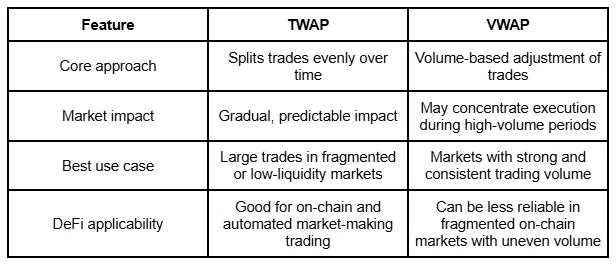
Implementing TWAP Strategies
The primary use case for a TWAP order in crypto is executing large orders. TWAP allows for slippage minimization and can also improve arbitrage execution by splitting trades into smaller increments, which reduces market impact.
It can also help liquidity providers manage their positions. By rebalancing gradually, they can adjust their positions with less market impact, especially in concentrated liquidity pools. All of this depends on how efficiently smaller trades can be executed. On SaucerSwap, this becomes much easier, thanks to low fees and fast transaction speeds.
Advanced TWAP Configurations
One of the advanced order-splitting strategies is the randomization we’ve mentioned earlier. It makes execution less predictable and reduces the likelihood that other participants will react to a detectable pattern.
You can also add price-based triggers to pause, accelerate, or skip trades based on market conditions. For example, a trade may be delayed until a more favorable price is reached before the next order is executed. Traders also often use hybrid execution algorithms that react to volatility or price movements.
Finally, all the above-described approaches can extend beyond a single trade. The TWAP trading strategy can be applied across multiple digital assets as part of broader portfolio strategies.
On SaucerSwap, tracking your holdings is straightforward via the portfolio dashboard. It gives you a real-time view of the tokens in your wallet — quantities, current values, and overall portfolio composition. Having this information readily available makes it easier to stay on top of your positions and make informed decisions.
Risks and Limitations
TWAP orders in crypto have limits, and the risks should be considered. First, because TWAP spreads execution over time, it reacts more slowly than strategies that execute orders immediately, which can be a disadvantage in trending markets. If prices are consistently trending in one direction, you may end up buying at higher prices or selling at lower prices due to TWAP execution.
Vulnerability over short time windows must also be considered. While TWAP can reduce the impact of single trades, it can still be subject to manipulation over short time frames, especially if the averaging period is too narrow.
These risks can be managed. Using longer time windows makes manipulation harder. Plus, historical testing can help you understand how a strategy performs under different conditions. And position sizing helps ensure that even if execution isn’t perfect, the impact stays controlled.
When to Use TWAP in Trading
If you need to enter or exit a position quickly, or you’re trading in a fast-moving market, waiting for an optimal average may cause you to miss the price movement. Thus, in certain cases, it can be more useful to trade quickly.
However, if you’re placing large trades, trading illiquid assets, or interacting with thinner pools, the TWAP algorithm can become a vital assistant in your execution strategy. Moreover, it is particularly effective in ecosystems like SaucerSwap, where, given its low transaction costs and near-instant finality on Hedera, it’s feasible to execute trades in smaller increments without significantly reducing returns.


