


Impermanent loss, or divergence loss, is part of the mechanics of automated market makers (AMMs) on decentralized exchanges. It happens when your position gets rebalanced as prices change, which can negatively affect your net returns.
Although this loss isn’t something you can avoid entirely, it’s an aspect to account for. Understanding how impermanent loss actually accumulates and, most importantly, how to manage risks when providing liquidity can help you make smarter decisions and stay in control of your positions.
What Is Impermanent Loss?
This is the difference between how much your assets are worth in DeFi liquidity pools and how much they would be worth if you didn’t deposit, but just held them. Impermanent loss occurs as a result of the price discrepancy of the tokens you’ve deposited. In AMMs, liquidity pools are constantly rebalanced to align the internal token’s prices with the real-world market value.
When one asset increases in value, the liquidity pool’s constant product formula rebalances the position by selling the rising asset to traders and, in turn, acquiring more of the asset that hasn’t increased as much. Consequently, you end up with more of the asset that performed worse (the one that either decreased or remained flat) and less of the asset that appreciated, which can lead to unexpected losses.
As long as your position is open and the token prices return to their original pool price ratio, this loss remains unrealized and eventually disappears. But if you exit the position before prices revert to their original ratio, the unrealized loss becomes permanent.
When holding assets in a private wallet, you fully benefit from the price appreciation of each individual token. But in a liquidity pool, this upside is reduced, which creates an opportunity cost — you give up part of the profit you could make from price increases in exchange for earning swap fees from trades.
The main question you should ask during liquidity provision is whether the AMM trading fees are sufficient to offset the risk. If the answer is yes, then you’re still in profit despite the loss. If the answer is no, passive holding is a more capital-efficient strategy for you.
Why Impermanent Loss Happens in AMMs
When you’re adding liquidity, you deposit two tokens of initially the same value, for instance, $100 each. The pool relies on an internal algorithm that determines the price of these tokens based on the ratio of assets currently held in the pool. If this balance shifts due to trading activity, the tokens' price adjusts accordingly.
Now, let’s say that one of the tokens appreciates in value in the outside market. Since it’s still cheaper in the pool for a short time, traders notice the price discrepancy and initiate an arbitrage trade, buying the token from the pool and paying with the other token. As a result, there’s now less of the rising token and more of the lower-value one. With each trade, the formula updates the price, gradually bringing it into line with the market.
This process is continuous. As prices adjust, the liquidity pool rebalances your position by exchanging your appreciating assets for the underperforming token to maintain the correct ratio. This means that, over time, your position shifts, and this is exactly how divergence loss happens.
A Simple Example
Here’s an example with figures to calculate impermanent loss when it occurs. Suppose you deposit into a liquidity pool where:
- 1 Asset A = $1
- 1 Asset B = $1
To keep the pool balanced at a 50/50 ratio by value, you deposit:
- 100 Assets A
- 100 Assets B
Your total deposit value is $200, split evenly between the two assets. Now, let's consider a situation where Asset A doubles in value:
- Asset A = $2
- Asset B stays at $1
If you had just held your assets, your position would be:
- 100 Assets A = $200
- 100 Assets B = $100
Total = $300
But, as we established, things work differently in DeFi liquidity pools. When the value of Asset A increases, arbitrage traders buy Asset A from the pool. This changes the balance of the pool, and you have fewer Assets A and more Assets B. After the pool rebalances, your share might look like:
- 70 Assets A
- 141 Assets B
Now, let’s calculate the value:
- 70 Assets A × $2 = $140
- 141 Assets B × $1 = $141
Total = $281. The $19 difference is your temporary loss. Although your total value increased from $200 to $281, compared to simply storing your assets in a wallet, your position is $19 lower.
Key Factors That Increase AMM Impermanent Loss
The extent of the loss can be impacted by a number of factors. Here are the main ones:
- Price divergence. The greatest liquidity provider risks don’t stem from how far a price moves, but from how the two assets move apart. When both tokens move up or down simultaneously, the ratio in the AMM pool remains unchanged. However, when assets diverge — one outperforms the other, or they move in opposite directions — the pool will have to aggressively sell the outperforming asset to buy the underperforming one. The wider the gap, the greater the loss relative to simply holding the token.
- Time in the pool. This is another driver of divergent loss. As the two assets in the pool diverge, losses continue to grow. For this reason, the longer a position is left open, the more likely the two assets are to diverge further, which increases potential losses. At the same time, the longer the position remains active and supported by trading volume, the more you’ll accumulate fees, which may lessen or even exceed the impact of loss.
- AMM and pool design. Standard crypto liquidity pools (like SaucerSwap V1) distribute your assets over the entire price curve (zero to infinity), so you don’t need to actively manage your position. In contrast, concentrated liquidity (SaucerSwap V2) allows you to specify individual price ranges for your assets. Although this approach may be more efficient from a capital perspective, it generally requires more active management and can lead to greater loss as the price moves within or beyond your chosen range.
How to Minimize AMM Impermanent Loss
It isn't possible to eliminate loss, as it’s inherent to AMMs. But there are ways to manage and reduce it. Here are a few strategies to consider.
1. Choose Less Volatile, Highly Correlated Pairs
As we’ve seen, pairs of assets that are likely to move in similar ways tend to have less divergence, which helps avoid impermanent loss. The tradeoff, however, is that stable pairs, being lower-risk, attract more liquidity and usually generate lower fees, so the overall yield tends to be more modest.
2. Avoid Extremely Volatile or Illiquid Tokens
With a high level of price volatility, there can be rapid pool changes. This often leaves you with less of the outperforming asset and more of the one that has lost value.
Illiquid tokens can be risky as well. In these types of liquidity pools, even small trades can result in significant and disproportionate price changes, which leads to frequent and uneven rebalancing. But if you focus on established assets with deep liquidity, you can reduce the frequency of aggressive rebalancing and maintain a more stable liquidity position.
3. Consider Stablecoin and “Blue-Chip” Pools
Pools that combine stablecoins with large, well-established crypto assets often strike a good balance between liquidity provider risks and returns. This is because stablecoins anchor a part of the position, while blue chips typically have more stable price behavior than smaller tokens. This creates a more predictable outcome, which can result in lower losses than volatile pairs, while offering more attractive yields than pools consisting solely of stablecoins.
4. Use Concentrated or Ranged Liquidity Carefully
Concentrated liquidity means your capital is only used within a chosen price range. This can increase the fees you earn because your capital is used more efficiently within this range.
This strategy, however, does come with some liquidity pool risks. If the market price suddenly moves outside the range you’ve established, your position will become inactive, and your overall liquidity will be trapped in a less valuable token. This means you won’t be able to earn fees and may incur greater losses. To mitigate impermanent loss risk, it’s important to actively monitor and adjust your range to stay aligned with the market.
5. Diversify Across Pools
Each pool behaves differently — some pools are more stable and offer lower returns, while others are more volatile but offer higher fee-earning opportunities. Thus, instead of putting all of your funds into a single pool and relying on a single position, you can reduce the risk of impermanent loss by distributing them over multiple pairs. If one pool underperforms or incurs unexpectedly large losses, steady returns from your other positions can help cushion the overall impact on your portfolio.
6. Account for Fees and Incentives
Divergence loss should always be viewed in context — it needs to be weighed against what you earn. Your earnings come from trading fees and, in some cases, liquidity provider rewards. Although a position may be negatively impacted by price divergence, you could still profit if your earnings are large enough.
It’s best to have a complete understanding of the situation. Before joining a pool, assess whether the anticipated fees and rewards will compensate for the potential price divergence. This is also the core of DeFi yield farming — balancing risk and reward to ensure your positions remain profitable.
7. Shorten Your Time Horizon in Highly Volatile Markets
In markets with high volatility, prices can diverge faster than fees can accumulate. In such cases, consider shortening your time horizon to reduce exposure to fast rebalancing. Furthermore, try not to open any new positions before large market events or during “high-impact” news cycles, as volatility can become highly unpredictable.
8. Use Tools and Analytics
Another core way to manage liquidity pool risks is to rely on data. Before entering a pool, you can use an impermanent loss calculator to estimate potential loss and determine whether it’s worth the trade. In addition, historical data can help determine whether a trading pair is stable or prone to swings.
When Is AMM Impermanent Loss Worth It?
The bottom line is that divergence loss is a standard aspect of participating in decentralized finance. It’s worth it when the trading fees collected plus additional rewards exceed the cost of the price change.
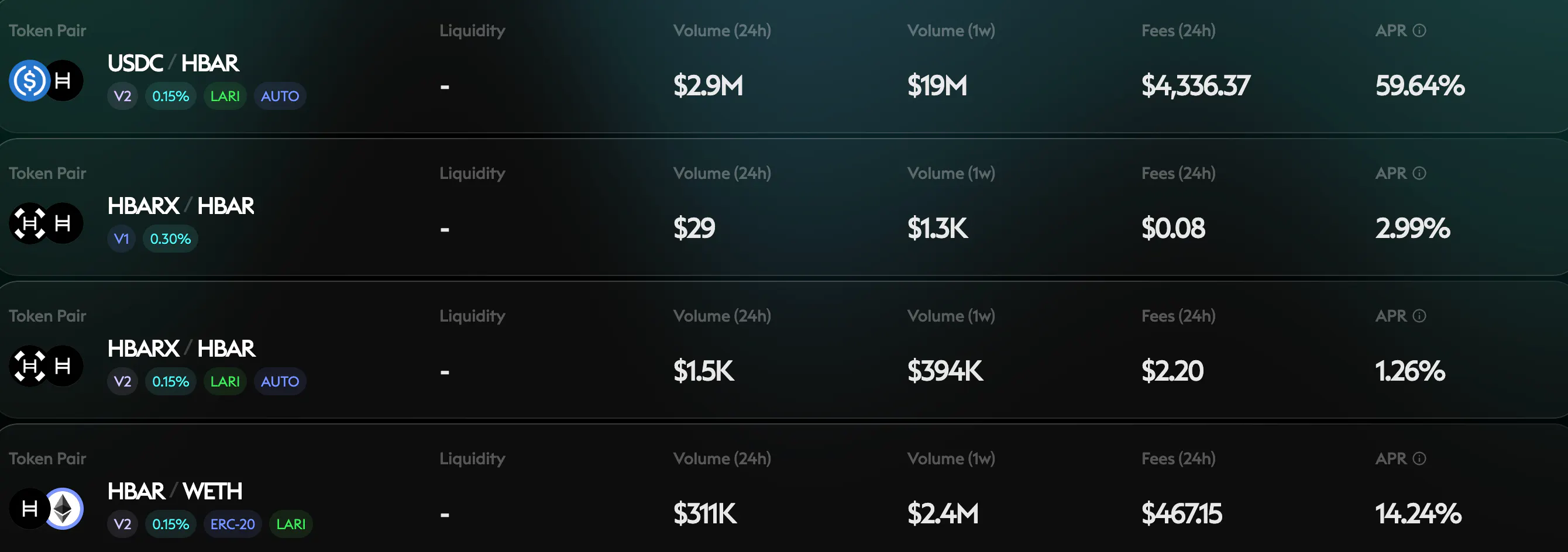
For example, in stablecoin pairs, price movement is limited, so loss remains low, and it’s likely the fees will compensate for it. More active pools, such as HBAR paired with a major asset, often have higher trading volume and therefore generate more fees to cover losses. Even in pools with highly volatile assets, liquidity providers can opt for short-term positions to capitalize on high trading volume and earn fees before significant price shifts occur.


